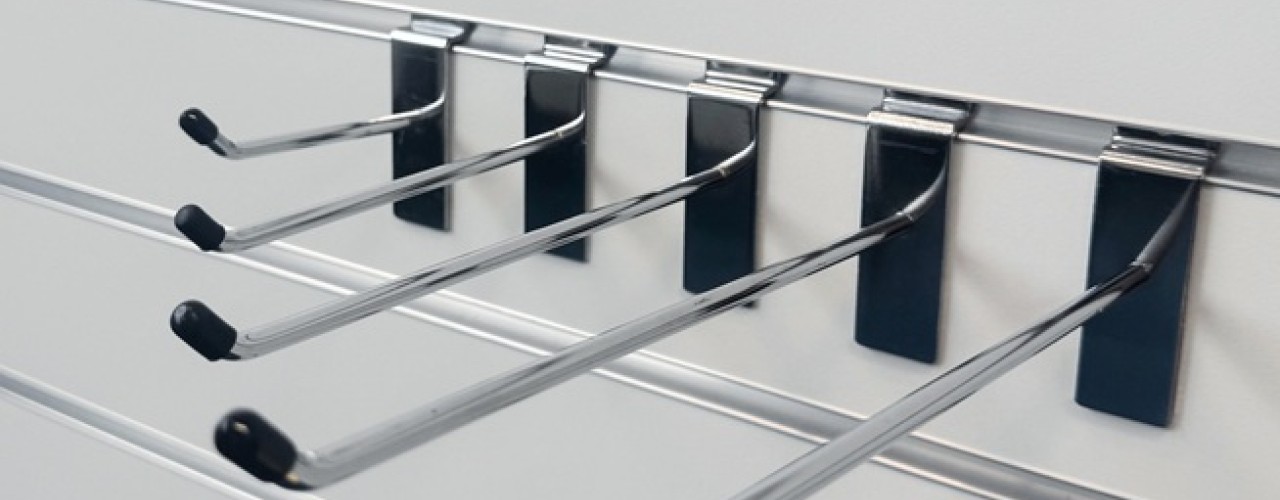
A metal rack featuring multiple slatwall hooks and a horizontal rod for hanging items.

How Slatwall Euro Hooks Can Transform Your Retail Displays

Retail displays are judged in seconds. Customers do not analyse fixtures or consciously assess layout choices, but they react instantly to how a space feels. Displays that look stable, clear and easy to browse invite interaction. Displays that feel cluttered or awkward quietly push customers away.

Slatwall systems have become a mainstay in retail for this reason. They provide a dependable framework that allows products to be presented cleanly while remaining adaptable. Within that framework, euro hooks play a practical role that often goes unnoticed until something goes wrong. When the right hooks are in place, displays hold their shape, products sit neatly, and the store feels organised without constant effort.

Why hardware decisions shape customer behaviour

Fixtures are often treated as background elements, yet they influence how customers move, browse and decide. A hook that bends under weight, allows products to overlap, or shifts when touched creates a subtle sense of disorder. Over time, those small issues add up.

Euro hooks are designed to work with retail packaging that uses euro slots, one of the most common hanging formats in shops. When paired correctly with slatwall panels, they support products evenly and keep displays aligned. That alignment helps customers scan options quickly, compare products easily, and trust what they are seeing.

Slatwall euro hooks do not draw attention to themselves. Instead, they remove friction from the shopping experience, which is often more valuable than visual impact alone.

Strength that supports daily retail demands

Retail environments are unforgiving. Hooks are pulled repeatedly throughout the day as customers browse and staff restock. Weight shifts constantly as products are removed and replaced. Over time, weak hardware shows its limits.

Strong hooks maintain their shape and position even under frequent use. This matters for safety, but it also matters for consistency. Displays that remain straight and stable throughout the day reflect care and professionalism, even during busy periods.

Slatwall euro hooks are designed to lock securely into the panel, reducing movement and maintaining alignment across long display runs. This stability means staff spend less time correcting displays and more time supporting customers.

Presentation that stays consistent

One of the biggest challenges in retail is keeping displays looking the way they were intended. A display may start the day perfectly organised and end it uneven and disordered simply due to customer interaction.

Euro hooks help preserve presentation because each product has a defined position and depth. When one item is removed, the rest remain aligned. When stock runs low, gaps are obvious and easy to address. This visual clarity makes maintenance simpler and faster.

Over time, this consistency shapes how customers perceive the store. Clean, orderly displays suggest reliability and attention to detail, qualities that influence purchasing decisions even when shoppers are not consciously aware of them.

Adapting displays without disruption

Retail layouts rarely stay the same for long. Product ranges evolve, promotions rotate, and seasonal changes demand quick updates. Fixed shelving struggles to keep up with this pace, often requiring time consuming adjustments or full refits.

Slatwall systems are designed for change, and euro hooks make that change practical. Hooks can be repositioned in moments, allowing displays to adapt without tools or downtime. This makes it easier to test layouts, respond to sales data, or introduce new products without committing to permanent alterations.

Using slatwall euro hooks allows retailers to refine displays gradually rather than overhaul them completely. That flexibility supports better decision making and reduces unnecessary cost.

Making better use of wall space

Wall space is one of the most valuable yet underused assets in retail. Slatwall panels turn walls into active display areas, and euro hooks make that space usable in a controlled way.

Products can be displayed vertically, freeing up floor space and improving customer flow. This is especially important in smaller stores or high traffic areas where clutter quickly becomes an issue.

Because euro hooks project products outwards consistently, displays remain accessible without intruding into walkways. Customers can browse comfortably, and staff can move through the space safely.

Supporting natural customer interaction

Good displays do not fight customer behaviour. Shoppers want to lift products, inspect packaging, and return items without disturbing the rest of the display.

Euro hooks support this behaviour by holding products securely while still allowing smooth removal. Items slide on and off easily, and remaining stock stays in place. This balance between stability and accessibility improves the overall browsing experience.

When customers feel comfortable interacting with products, they spend more time at the display. That increased engagement often translates into stronger sales performance.

Versatility across different product types

Retail displays rarely contain one uniform product. Sizes vary, packaging changes, and stock levels fluctuate. Display hardware must accommodate this variation without compromising presentation.

Euro hooks are available in different lengths and configurations, allowing retailers to match depth and capacity to each product type. Shorter hooks suit compact or premium items, while longer hooks support higher volume lines.

This versatility means a single slatwall system can support multiple categories without constant reconfiguration. Over time, this simplifies display management and keeps the store adaptable.

Organisation beyond the shop floor

Display efficiency does not stop at the customer facing area. Back of house spaces also benefit from clear, visible storage.

Using slatwall euro hooks in stockrooms or preparation areas keeps tools, accessories and overflow stock easy to locate. Items are returned to the same position each time, reducing confusion and saving time during restocking.

These operational improvements may seem small, but across a trading week they have a noticeable impact on efficiency and staff workload.

The importance of manufacturing quality

Inconsistent hardware creates inconsistent displays. Hooks that vary slightly in size, strength or finish disrupt alignment and weaken overall presentation, especially across larger installations.

Manufacturing quality ensures uniform performance. With items made and finished in house, Foxbarn maintains control over strength, fit and finish. This consistency matters for retailers rolling out displays across multiple locations or large wall runs.

Reliable supply also matters. Large UK stockholdings mean replacement hooks or additional quantities can be delivered quickly, keeping displays consistent over time.

Building displays that last

Retail fixtures should support long term use, not create ongoing maintenance issues. Slatwall euro hooks offer durability and adaptability that protect your investment.

As product ranges change and layouts evolve, hooks continue to perform without needing replacement. Displays remain relevant rather than becoming outdated, which reduces waste and unnecessary cost.

Choosing the right hardware from the outset creates a foundation that supports growth rather than limiting it.

Bringing structure and flexibility together

Strong retail displays balance order with adaptability. Slatwall systems provide the structure, and euro hooks deliver the flexibility that allows stores to respond to change without losing organisation.

When slatwall euro hooks are matched carefully to your products and space, displays become easier to manage, easier for customers to use, and easier to update as your business evolves.

If you are reviewing your current displays or planning a new layout, Foxbarn can help you select hook solutions that suit your products, space and commercial goals. With decades of manufacturing experience, large UK stockholdings and fast nationwide delivery, our team can support everything from small updates to full retail rollouts.

To discuss your requirements or get advice on the right slatwall euro hooks for your store, contact Foxbarn today and speak to a team that understands retail displays inside and out.
Slatwall Hooks Creating Organised Retail Displays

Why Slatwall Hooks Are Essential for Organised Retail Spaces

Organisation in retail is rarely about appearances alone. It affects how customers move through a store, how easily products are understood, and how efficiently staff can manage stock. When displays feel cluttered or inconsistent, shoppers disengage quickly. When everything has a clear place, the space feels calmer, easier to navigate, and more trustworthy.

Slatwall systems have become a staple in retail environments for exactly this reason. They offer structure without rigidity and order without limiting change. At the centre of that system sit the hooks. Used well, slatwall hooks create displays that are flexible, scalable and easy to maintain, which is why they play such an important role in organised retail spaces.

From home organisation to retail efficiency

Slatwall is often discussed in the context of home storage because it solves everyday organisational challenges in a simple way. Walls become functional, items stay visible, and layouts adapt as needs change. Those same principles apply directly to retail, just at a different scale.

In a store, space works harder. Displays must hold stock, communicate value, support browsing, and remain tidy throughout the day. Retailers cannot afford fixtures that only work in one configuration or require constant adjustment. Slatwall systems meet these demands by offering a stable framework that supports frequent change.

By transferring the logic of home organisation into a retail setting, slatwall hooks help stores remain adaptable without losing control.

Making the most of vertical display space

Floor space in retail is always limited. Every square metre needs to earn its place, which is why wall based merchandising is so effective. Slatwall allows retailers to shift product displays upwards, freeing up walkways and reducing reliance on bulky fixtures.

Hooks make that vertical space usable. They allow products to be displayed clearly at different heights while maintaining alignment and spacing. This improves visibility and encourages browsing, especially when products are positioned at eye level.

Using slatwall hooks means displays can be expanded vertically without creating visual clutter. Products remain clearly separated and easy to reach, which supports both customer experience and staff efficiency.

Flexibility that supports changing ranges

Retail never stands still. Product lines change, packaging evolves, and seasonal ranges rotate throughout the year. Fixed shelving struggles to keep pace with that level of movement.

Slatwall systems are designed for flexibility, and the hooks are what make that flexibility practical. Hooks can be moved, swapped or replaced without tools or disruption. This allows retailers to adjust displays quickly in response to new stock or sales patterns.

Rather than redesigning an entire display, staff can make small, targeted changes that keep the layout relevant. Over time, this saves both time and cost, while allowing stores to stay responsive.

Improving product visibility and clarity

Customers make decisions based on what they can see and understand. Displays that overlap, lean or hide key information create friction. These hooks support clean presentation by holding products in consistent positions.

When items are evenly spaced and aligned, customers can compare options easily. Pricing, branding and packaging remain visible, which reduces confusion and speeds up decision making. This is particularly important in categories where shoppers want to scan multiple options before choosing.

By using hooks that suit the size and weight of each product, retailers maintain clarity across the display. That clarity builds confidence and encourages engagement.

Supporting intuitive customer interaction

Retail displays should feel natural to use. Customers want to pick up products, examine them, and return them without effort. When fixtures resist that interaction, displays suffer.

Hooks create a balance between stability and accessibility. Products remain secure while still being easy to remove and replace. This supports browsing behaviour without constant disruption to the display.

Slatwall hooks contribute to this experience quietly. They do not draw attention to themselves, but they shape how customers interact with the space. When displays feel intuitive, customers spend more time exploring and less time feeling frustrated.

Maintaining organisation throughout the trading day

Even the best designed displays can deteriorate quickly in busy stores. Items are removed, replaced incorrectly, or left out of alignment. Over time, this creates a sense of disorder that affects the entire space.

They also help maintain organisation because each product has a defined position. When something is missing, it is immediately obvious. When stock is returned incorrectly, it stands out.

This visual feedback encourages staff to maintain displays without constant intervention. Organisation becomes part of the system rather than an ongoing task. For retailers managing high footfall, this makes a meaningful difference.

Reducing clutter and improving flow

Clutter disrupts flow. When products crowd each other or spill into walkways, customers slow down or disengage. Slatwall systems reduce this risk by lifting displays off the floor and keeping products contained within a defined area.

Hooks play a key role by controlling depth and spacing. Products project from the wall in a consistent way, which keeps aisles clear and movement predictable. This improves safety and comfort, particularly in smaller stores.

Clear flow also benefits staff. Restocking becomes easier when displays are accessible and predictable, reducing time spent adjusting or reorganising fixtures.

Durability in demanding retail environments

Retail fixtures are handled constantly. Hooks must support repeated use, varying weights and frequent adjustments without losing shape or grip. Poor quality hooks bend, loosen or fail, creating safety risks and maintenance issues.

High quality slatwall hooks are designed to withstand these demands. Consistent manufacturing ensures they fit securely within the panel and hold products reliably. This stability protects both stock and customers.

Durability also supports long term planning. Retailers can rely on their fixtures to perform consistently across different layouts and product ranges.

Back of house organisation

Organisation does not stop at the shop floor. Stockrooms, preparation areas and staff zones benefit just as much from clear, visible storage.

Using these specific hooks in these spaces keeps tools, accessories and overflow stock accessible. Items are easy to locate and return, which supports smoother operations and faster restocking.

Retail efficiency is built on small improvements that add up. Reducing time spent searching for equipment or stock has a direct impact on productivity.

Manufacturing expertise and consistency

For larger retail environments, consistency matters. Hooks that vary in size, finish or fit can disrupt alignment across a display. This is particularly noticeable in long slatwall runs or multi store rollouts.

Manufacturing expertise ensures uniformity. With in house production and strict quality control, hooks perform consistently across every installation. This reliability supports both aesthetics and safety.

Foxbarn’s experience supplying retail fixtures means displays can be designed with confidence. A wide range of hooks allows retailers to match hardware precisely to their product mix, while UK stockholding supports fast delivery and ongoing supply.

Bringing structure and flexibility together

Organised retail spaces do not happen by chance. They are the result of thoughtful display choices that support how your store operates day to day. Slatwall systems provide the structure, and the right hooks give you the flexibility to adapt, present products clearly, and maintain order as ranges change.

When slatwall hooks are matched correctly to your products and space, displays become easier to manage, easier for customers to use, and easier to update over time. That consistency supports better presentation and smoother retail operations across the entire store.

If you are reviewing your current displays or planning a new layout, Foxbarn can help you choose slatwall hook solutions that suit your products, space and commercial goals. With decades of manufacturing experience, large UK stockholdings and fast nationwide delivery, our team can support everything from small updates to full retail rollouts.

To discuss your requirements or get advice on the right slatwall hooks for your store, contact Foxbarn today and speak to a team that understands retail displays inside and out.

Pegboard hooks used in retail display

Which Pegboard Hooks Are Best for Your Retail Displays

Retail displays succeed or fail on detail. Customers may not consciously analyse how a product is presented, but they respond immediately to clarity, order and ease of access. When displays feel intuitive, shoppers browse longer, handle products with confidence and move through the space without friction. Pegboard systems support this kind of experience, but the board itself is only part of the equation. The real performance comes from the hooks.

Choosing the right pegboard hooks is not about filling holes on a panel. It is about understanding weight, spacing, product type and how customers interact with what you sell. The wrong hook can lead to clutter, damaged packaging or unstable displays. The right hook supports visibility, flow and organisation across your store.

Why hook choice matters more than layout

Many retailers focus on layout first, where displays sit, how wide aisles are, or which wall holds which category. Those decisions matter, but they only work when the display hardware supports them properly.

Hooks dictate how products hang, how far they project from the wall, and how easily customers can remove and replace items. A poor match between hook and product leads to displays that feel awkward to use. Stock may lean, overlap or fall out of place. Over time, this creates a messy appearance that undermines trust in the product itself.

Well chosen pegboard hooks keep products aligned, accessible and visually consistent. That consistency helps customers understand pricing, compare items and make decisions without effort.

Understanding the different hook styles

Not all hooks serve the same purpose. Retail displays often carry a mix of lightweight, packaged and boxed products, each requiring a different approach.

Single prong hooks are among the most common options. They suit lightweight items and allow clear, individual presentation. Because each hook holds a defined number of products, stock levels remain easy to monitor. This is particularly useful in high turnover areas where restocking needs to be quick and obvious.

Double prong hooks provide greater stability and are better suited to slightly heavier products or wider packaging. By supporting items at two points, they reduce swing and movement when customers interact with the display. This improves durability and helps maintain neatness throughout the trading day.

Looped hooks are designed to prevent products from sliding off unintentionally. They are often used where security or stability is a concern, especially in busy environments. The loop creates a natural stopping point, keeping stock in position even when displays are heavily handled.

A well planned display will often use a combination of hook styles rather than relying on one solution throughout.

Durability and material quality in retail settings

Retail environments are demanding. Hooks are handled repeatedly, subjected to weight shifts and exposed to constant movement. Over time, low quality hooks bend, loosen or fail altogether. This creates safety issues and increases maintenance costs.

High quality pegboard hooks are manufactured with durability in mind. Strong materials and consistent finishes ensure hooks retain their shape and grip, even under frequent use. This stability supports both safety and presentation.

Durability also affects long term value. Replacing bent or damaged hooks disrupts displays and adds avoidable expense. Investing in reliable hardware from the outset reduces downtime and protects the appearance of your store.

Matching hooks to product type

Every product behaves differently on display. Flat packaged items sit differently to boxed goods or hanging accessories. The hook must suit both the weight and the way the product is packaged.

For blister packs and hanging retail packaging, straight hooks with appropriate length work well. The key is ensuring enough depth to display multiple units without overcrowding. Too short, and the display empties quickly. Too long, and products can sag or overlap.

Heavier boxed items require stronger hooks with secure positioning. In these cases, spacing becomes just as important as hook strength. Adequate room between hooks prevents products from knocking against each other and keeps labels visible.

Using pegboard hooks that align with the product’s physical characteristics improves presentation and reduces damage caused by poor support.

Improving customer interaction through hook selection

Retail displays should invite interaction, not discourage it. Customers want to pick up products, examine them and return them easily. When hooks are too tight, too loose or poorly positioned, this process becomes frustrating.

Hooks that hold products securely while allowing smooth removal strike the right balance. Customers should not need to wrestle items free, nor should products fall when one is removed.

This balance affects perception. Displays that feel easy to use signal quality and care. Displays that feel awkward suggest poor organisation or low standards, even if the product itself is sound.

The right pegboard hooks contribute quietly to this experience, supporting natural browsing behaviour.

Flexibility for changing retail demands

Retail is rarely static. Ranges change, packaging updates and seasonal promotions come and go. Display hardware must keep up without requiring full refits every time something changes.

Pegboard systems offer flexibility by design, but hook choice enhances that flexibility. Using a variety of hook lengths and styles allows quick adjustments without replacing the entire setup.

This adaptability reduces downtime and helps stores respond quickly to new stock or promotional activity. It also allows you to test layouts and refine them based on customer behaviour.

A well stocked range of hooks gives you control over your displays rather than forcing compromises.

Supporting organisation behind the scenes

The benefits of good hook selection extend beyond the shop floor. Stockrooms, back of house areas and preparation zones also rely on organised storage.

Using pegboard hooks in these spaces keeps tools, accessories and overflow stock visible and accessible. This reduces time spent searching for items and supports smoother restocking routines.

Operational efficiency matters. Retail studies show that staff spend a significant portion of their time locating stock and equipment. Improving organisation through visible storage directly supports productivity.

Why manufacturing expertise matters

Not all hooks are created equal. Manufacturing quality affects fit, strength and consistency across large installations. Hooks that vary slightly in size or finish can create uneven displays and alignment issues.

Foxbarn’s experience in manufacturing display hooks and fixtures ensures consistency across every product supplied. With items made and finished in house, quality control remains tight and reliable. This level of control supports large scale retail installations where uniformity matters.

Supplying a wide range of pegboard hooks allows retailers to build displays that are both practical and tailored to their product mix. Access to large UK stockholdings also means solutions can be delivered quickly, supporting tight schedules and store rollouts.

Long term display performance

Retail displays are an investment. They should support sales over time, not create ongoing maintenance issues. Choosing the right hooks contributes directly to display longevity.

Strong hooks maintain alignment, reduce damage to products and keep displays looking orderly throughout the trading day. This consistency reinforces customer confidence and supports repeat visits.

Rather than viewing hooks as interchangeable components, it is worth considering their role in the overall display strategy. Small details have a cumulative effect on how a store feels and functions.

Making the right choice for your store

Selecting pegboard hooks comes down to understanding your products, your customers and how your space operates. There is no single hook that suits every display, but there is a combination that will suit your store perfectly.

By focusing on durability, suitability and flexibility, you create displays that are easier to manage and more appealing to customers. With the right expertise and manufacturing support behind you, pegboard systems become a reliable foundation rather than a compromise.

The question is not which hook looks right on the wall, but which one supports your products, your staff and your customers day after day. Get in touch with us today.

Pegboard Pegs Used for Wall Storage

How Pegs on Pegboards Can Maximise Your Space

Space has a habit of filling itself. No matter how organised a room starts out, items accumulate, routines change, and storage that once worked begins to feel restrictive. The challenge is rarely about having more space, but about using what you already have more intelligently.

Pegboard systems have been used for decades because they solve this problem in a straightforward, practical way. When combined with the right pegs and hooks, a pegboard becomes a flexible surface that adapts to how you live or work. A pegboard setup with pegs allows you to move storage off desks, floors and worktops and onto walls, where space is often underused.

What makes this approach so effective is not complexity, but control. You decide where items sit, how much space they take up, and how easily they can be reached. As those needs change, the layout changes with them.

Why vertical space matters more than you think

Most rooms have one thing in common. Walls are used far less efficiently than floors. Shelves, cupboards and storage units often occupy valuable ground space, even though the walls around them remain largely empty.

A pegboard shifts storage into this unused area. Instead of stacking items on top of one another or hiding them away, everything sits at eye level. This improves visibility and access, which has a measurable effect on how spaces are used.

Studies into workplace efficiency suggest that poor organisation and storage can cost employees up to 30 minutes a day through searching and unnecessary movement. While that data often relates to offices and workshops, the same principle applies at home. When items are visible and clearly placed, you spend less time looking for them and more time using them.

A pegboard with pegs system turns a wall into active storage rather than dead space.

How pegboards adapt as your needs change

Fixed storage solutions work well when your requirements stay the same. In reality, they rarely do. Tools change, equipment grows, products rotate, and workflows shift.

This is where pegboards stand apart. Because pegs can be moved without tools or permanent alterations, the board evolves with you. Hooks can be spaced further apart, grouped closer together, or repositioned entirely within minutes.

That adaptability removes a common frustration with shelving and cabinets. You are no longer locked into a layout that made sense once but no longer fits your routine. Instead, storage responds to how you actually use the space today.

This is particularly useful in environments where flexibility matters, such as home offices, creative studios, workshops, and retail back rooms.

Organisation that stays organised

Many storage systems look tidy on day one and slowly descend into clutter. This usually happens when returning items becomes inconvenient. If something does not have a clear place, it ends up wherever there is room.

Pegboards work differently. Each item has a visible, defined position. When something is removed, the empty space is obvious. That visual cue encourages items to be put back, which helps organisation last rather than fade.

A pegboard layout supports this behaviour by making organisation simple rather than forced. There are no doors to open, drawers to search through, or stacks to disturb. Everything is visible, and everything has a place.

Over time, this reduces clutter naturally, without the need for constant tidying.

Using pegboards in the home without clutter

Pegboards are often associated with garages or workshops, but their value in domestic spaces is just as strong. Modern interiors benefit from storage that is practical without feeling heavy or intrusive.

In kitchens, pegboards allow utensils, pans and frequently used tools to be stored within reach, freeing up drawer and cupboard space. In home offices, they provide a way to organise cables, stationery and devices without crowding desks. Craft rooms, utility rooms and even hallways can benefit from vertical storage that adapts to changing needs.

The key is proportion and placement. Pegs on pegboards don’t need to dominate a wall to be effective. Even a modest section can relieve pressure on other storage areas and improve how the room functions.

Because layouts can be adjusted, the system continues to work even as household routines change.

Supporting productivity in office environments

Offices rely on flow. When tools, supplies or equipment are difficult to access, productivity drops. Pegboards help restore that flow by keeping shared items visible and accessible.

Instead of relying on cupboards that hide contents or desks that become cluttered, pegboards create a central point for storage. This works well in shared spaces where consistency matters. When everyone knows where items belong, time spent searching drops significantly.

A pegboard system also supports cleaner desks, which has been linked to improved focus and reduced distractions. Research into workplace environments suggests that visual clutter can reduce concentration and increase stress. Pegboards counter this by keeping items organised without removing them from sight completely.

For technical teams, studios or facilities teams, pegboards also improve accountability. Missing tools are immediately noticeable, which helps prevent loss and unnecessary replacement.

Retail and commercial advantages

In commercial settings, space efficiency directly affects performance. Wall based storage and display systems allow businesses to present more products without overcrowding floor space.

Pegboards are widely used in retail because they allow fast layout changes without specialist installation. Product spacing can be adjusted to suit packaging size, stock levels or promotional needs. This reduces downtime and supports seasonal changes.

A pegboard pegs display also improves customer interaction. Products are clearly visible, easy to browse and simple to remove. This encourages engagement and reduces frustration, particularly in high traffic areas.

Retail research consistently shows that clear, organised displays increase dwell time and support purchasing decisions. Customers are more likely to interact with products they can see and reach easily.

Flexibility without long term commitment

One of the less obvious benefits of pegboards is the freedom they offer. Traditional storage often requires a long term commitment to a specific layout. Once installed, changing it can be costly or disruptive.

Pegboards avoid this entirely. Layouts can be tested, adjusted and refined over time without permanent changes. This is valuable for growing businesses, evolving households and anyone unsure of future requirements.

This system allows you to start simple and expand gradually. Additional pegs can be added as needed, and layouts can be refined as usage patterns become clearer.

This reduces wasted investment and ensures storage remains useful rather than outdated.

Improving accessibility and safety

Good storage is not only about organisation, it is also about safety and ease of use. Items stored on floors or in unstable stacks increase the risk of trips, spills and damage.

Pegboards move items off the ground and into secure positions. Frequently used items can be placed at comfortable heights, reducing strain and unnecessary movement.

In work environments, this has tangible benefits. Clear storage reduces accidents linked to clutter and improves compliance with basic safety expectations. In homes, it creates cleaner, more navigable spaces that are easier to maintain.

This setup also supports safer habits by making good organisation the easiest option.

Making storage work harder

Space limitations are rarely solved by adding more furniture. More often, they are solved by using existing space more effectively.

Pegboards achieve this by turning walls into working surfaces. They provide flexibility, visibility and control without adding bulk or complexity. Because layouts can change as needs change, the system continues to deliver value over time.

Having Pegboard Pegs is not about decoration or trends. It is about making space work harder, staying organised, and avoiding the compromises that come with fixed storage.

If your space feels constrained, cluttered or inefficient, the question is not how much space you have. It is how well you are using it. Get in touch with our team today.